Living room lighting ideas
The renovating.co.uk team · Prices checked 27 Sep 2026
For better living room lighting, swap the cool white bulb for a warm one, put the ceiling light on a dimmer, then add a floor lamp and a small table lamp so the light comes from three heights. In most living rooms that's the whole job, and the lamps are the cheap part.
Here it is in four steps, in a living room we designed with real IKEA and B&Q products, so you can see what each step does on its own.
What do the four steps look like in a room?
This is a compact modern living room we designed, roughly 3.3m x 4.6m: a black leather two-seater (IKEA LANDSKRONA, £699), a round black and glass coffee table (IKEA FRÖTORP, £149), a white gloss TV bench (IKEA BYÅS, £115), white curtains and steel grey walls (Dulux Heritage Pewter Plate, £49). The only light is a black pendant from B&Q (GoodHome Yarra, £40).
The pictures show the same evening, with the curtains closed, from the doorway. Only the lighting changes. The walls are the same paint in all four.
First, the pendant with a cool white bulb, the kind sold as daylight.
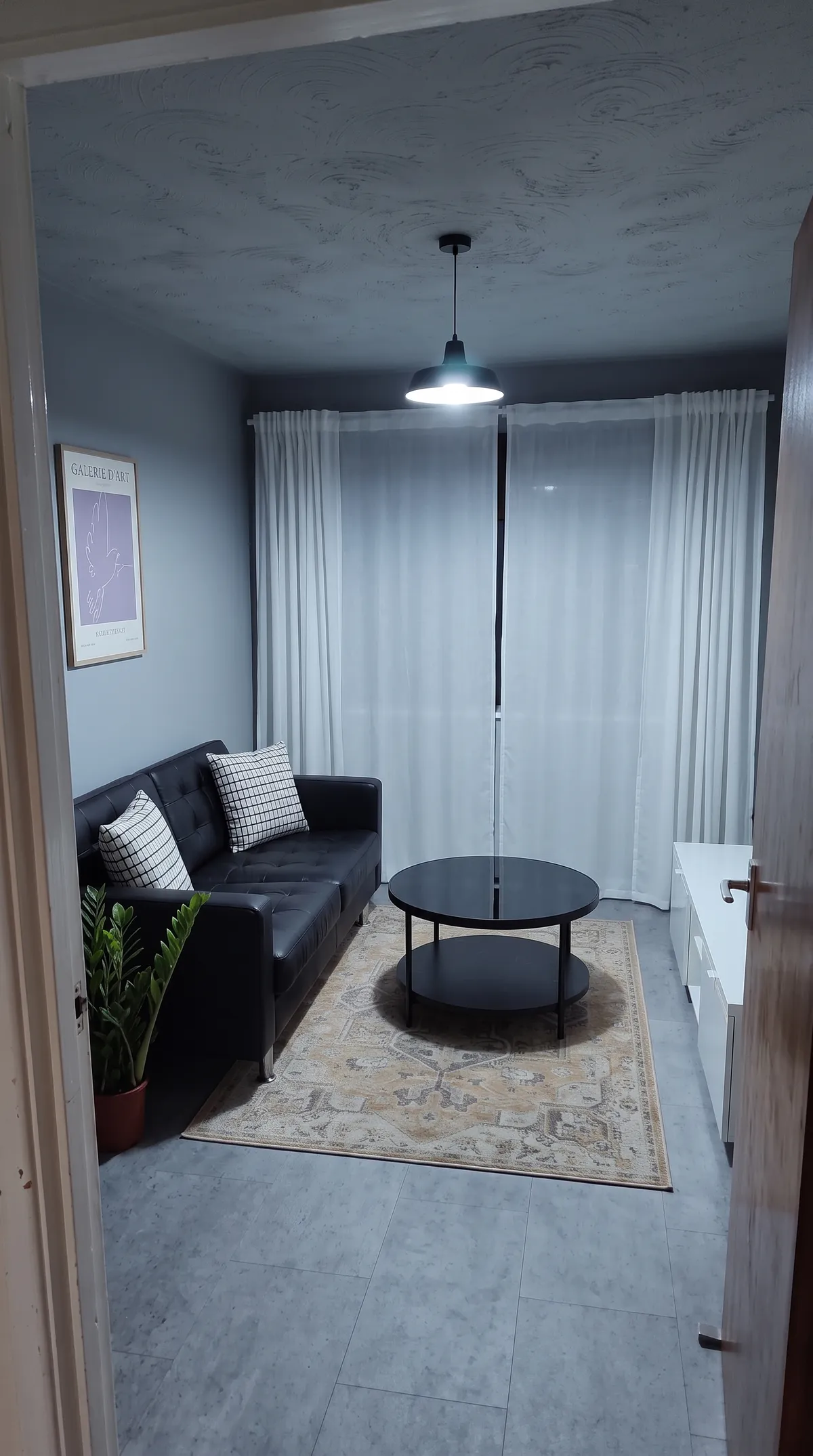
It's flat and a bit clinical. The walls go blue-grey, the ceiling texture shows up as hard shadows, and the black leather looks like it belongs in a waiting room. Nothing is wrong with the furniture. It's the bulb.
Second, the same pendant with a warm white bulb, turned down on a dimmer.
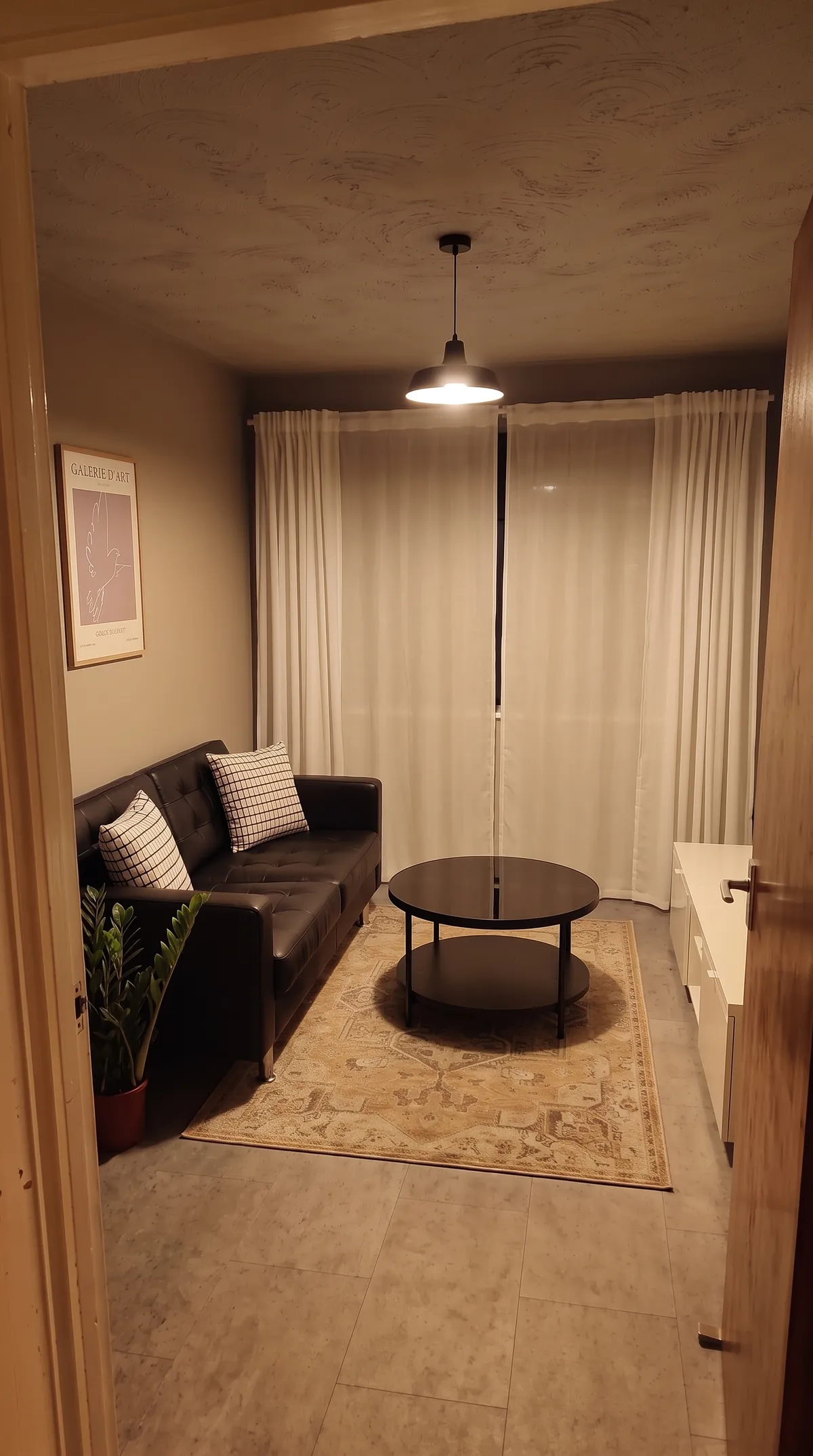
The grey walls now read as warm taupe, the shadows soften, and the room looks like somewhere you'd sit in the evening. It needs no new furniture, and it's the biggest single change of the four.
Third, a floor lamp in the corner by the sofa, lit with the same warm bulb colour.
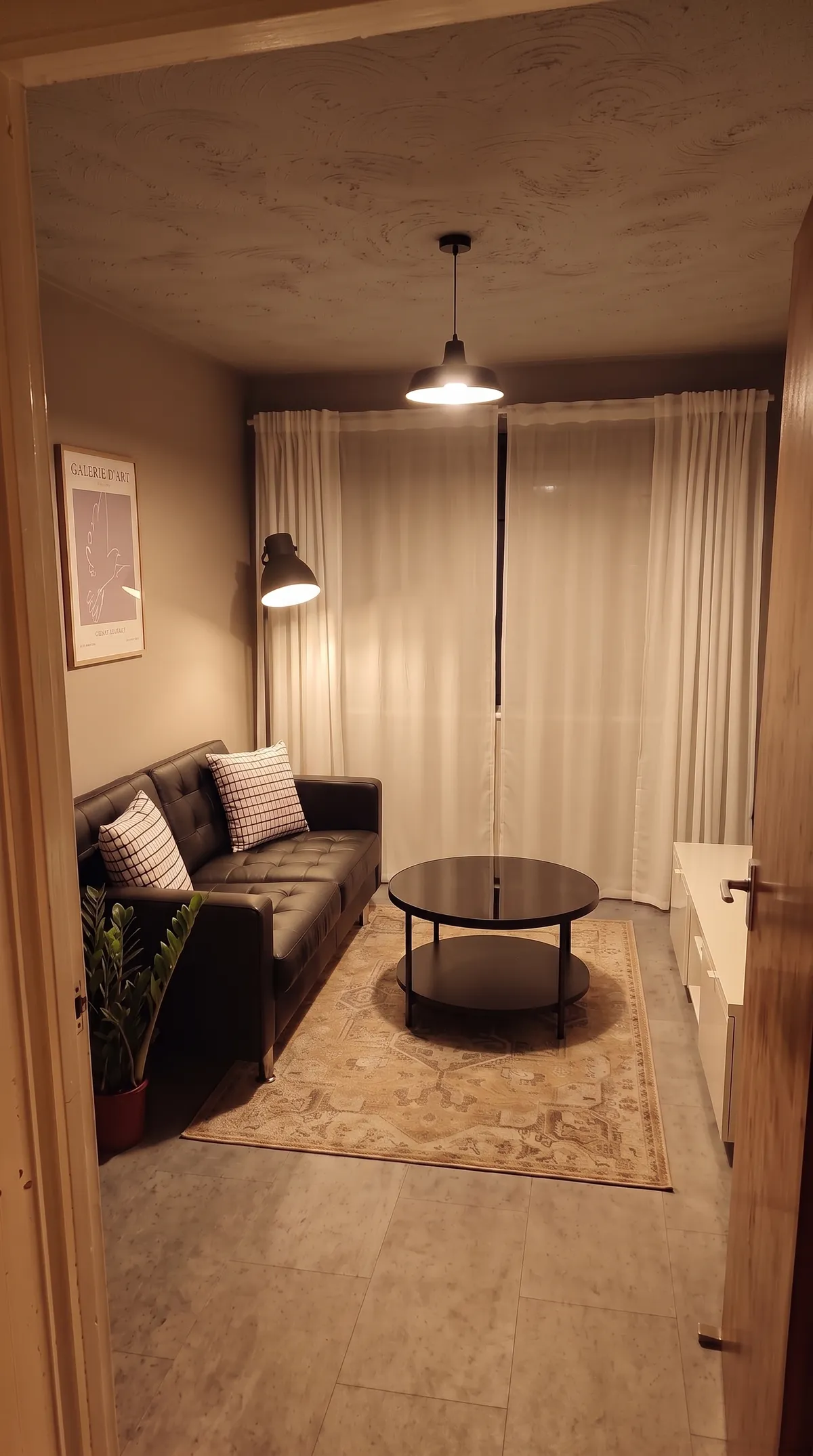
The corner that was dark in the last picture now has a pool of light, and the curtains behind it glow. The ceiling light can go lower because it's no longer doing all the work.
Fourth, a table lamp at the other end of the sofa, on a small side table by the TV bench.
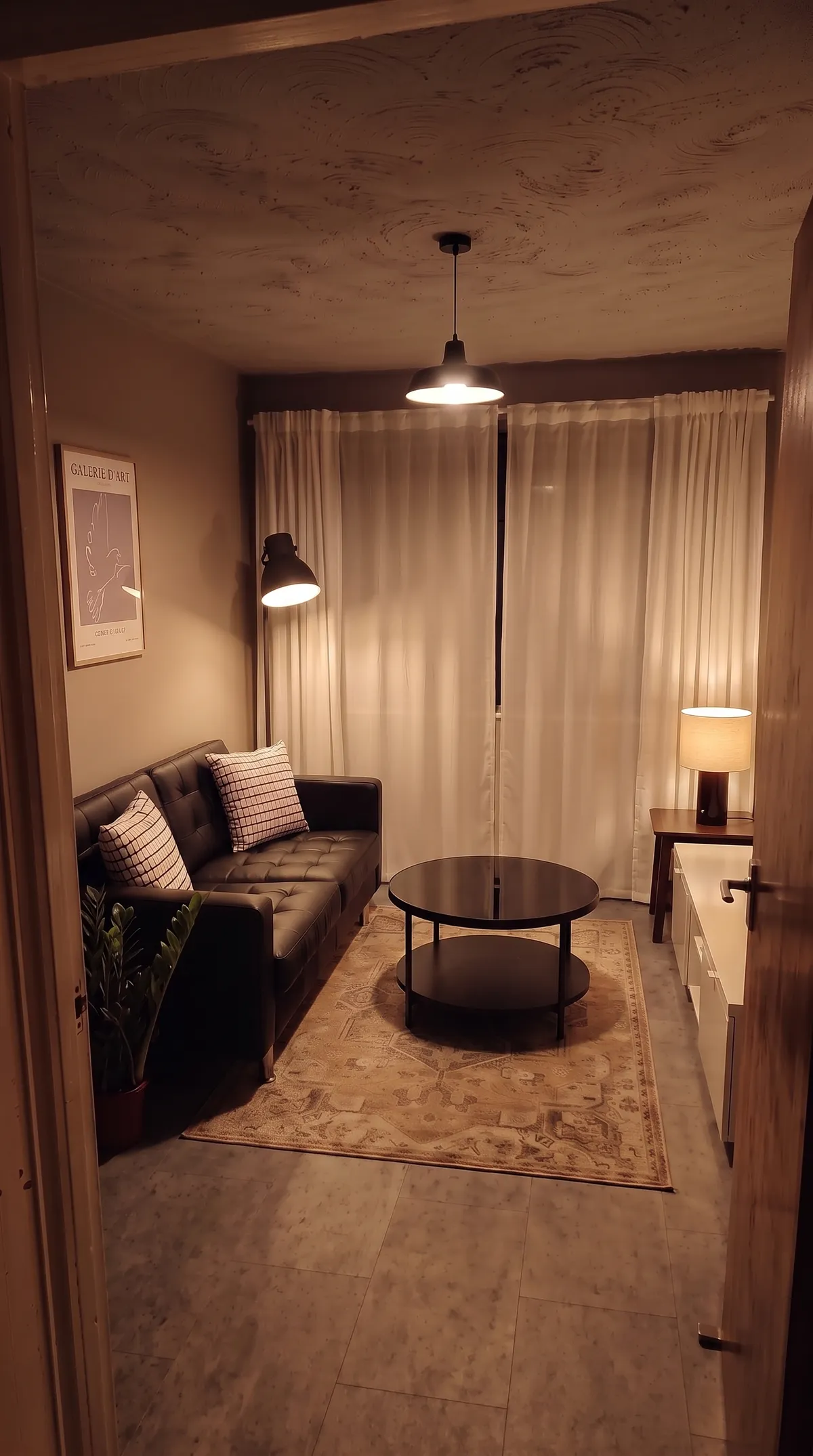 BeforeAfter‹›
Now there are three lights, at three heights: the pendant high, the floor lamp in the middle, and the table lamp low. The light no longer comes from one place.
What bulb should you use in a living room?
A warm white one, around 2700K. Retailers mostly agree. Light Trend suggests 2700K to 3000K for a cosy glow, and Evelyn Lily Interiors mentions around 2700K as warm white. One lamp retailer goes wider, 2200K to 3000K, and calls 2700K the most flexible.
IKEA points you to warm-toned bulbs and textured shades. Look for "warm white" and 2700K on the box. The first picture uses a bulb sold as cool white, the opposite end of the scale.
One practical point: keep every bulb in the room at the same colour. A warm lamp next to a cool ceiling light looks like a mistake.
Do you really need a dimmer?
We'd say yes for the main light, because it's the one that's too bright for the evening. A dimmer also lets the ceiling light stay on without dominating. Evelyn Lily Interiors says dimmers can cut down how many lights you need, so it's worth trying one first if you're short of space or money.
Two things to check. The bulb has to be dimmable, and it will say so on the packaging. And if you'd rather not touch the wall switch, a lamp with its own dimming gets you part of the way: the table lamp here (IKEA HALGATT) is dimmable. If you're not confident swapping a switch, that's a job for an electrician.
How many lights does a living room need?
Three is a good start, and we'd go to four in a bigger room. One lamp retailer, Warm by Design, suggests a floor lamp for height, a table lamp near the sofa and a lower accent lamp, with a fourth in a larger room. The lamp retailer Letifly says most cosy rooms work better with two to four sources than one bright fixture.
Where they go matters as much as the count. In the pictures the lamps are at opposite ends of the sofa, one in the corner by the window and one by the TV bench, rather than both on one wall. Warm by Design warns against lining every lamp along one wall.
How bright should the lamps be?
Brighter than you'd think for the ceiling light, softer for the lamps. Light Trend gives 450 to 800 lumens for a table lamp and 800 to 1,600 for a main fixture. The lamp retailer Letifly gives 400 to 800 for table lamps and 800 to 1,100 for floor lamps. The ranges overlap enough to use: a table lamp around 500 lumens and a floor lamp around 800.
The lumens are printed on the bulb's box, so check it against those ranges before you buy.
What did it cost?
The room's 11 products come to £1,285.44, with the pendant at £40, and none of them is a lamp. The two lamps in the pictures cost:
- IKEA HEKTAR floor lamp, dark grey: £79
- IKEA HALGATT table lamp, dimmable beige/brown ceramic, 49cm: £35
That's £114, bringing the room to £1,399.44 for 13 products, so the lamps are about 8% of the total. The side table the lamp sits on isn't one of the room's listed products, so it isn't in that figure either, and neither is the warm bulb or a dimmer switch.
IKEA sells cheaper lamps, though they aren't shown in this room. The cheapest floor lamp is BARLAST at £8 (150cm), and AKTERSPRING in opal glass and brass is £40 (162cm). For the table lamp, HALGATT in white (35cm) is £25, ÅSKMULLER (dimmable, 24cm) is £19, and BARLAST is £4. The cheapest pair comes to £12, against the £114 here.
The trade-off is that HEKTAR is the only floor lamp you can see in this room, and its angled head throws light onto the wall and curtains. Check the shape of any cheaper lamp before you swap, especially if you read in that corner.
How do you check it at home?
Do it one step at a time, in the evening with the curtains closed, because that's when the room is used and when a single ceiling light looks its worst.
- Look at the ceiling light on its own. If the walls look grey or blue, check the bulb's colour on the box.
- Fit a warm white bulb (2700K) and turn the light down if you can. If you can't, note how harsh it is at full brightness.
- Bring in one lamp from another room and put it in the darkest corner by the sofa. Keep its bulb warm too.
- Add a second lamp, lower down, at the other end of the sofa.
- Stand in the doorway and look for dark patches, then move a lamp a metre and look again.
If you've got the lamps, try the ceiling light off and the lamps on, to see how much work the ceiling light is still doing.
FAQ
What lighting do you need in a living room?
Three sources at different heights: a ceiling light on a dimmer, a floor lamp and a table lamp, all with warm white bulbs. Add a fourth in a bigger room.
What colour bulb is best for a living room?
Warm white, around 2700K. Some retailers go up to 3000K, but cool white and daylight bulbs tend to make a living room look flat in the evening.
Is a floor lamp or table lamp better for a living room?
Both, at different heights. A floor lamp fills a dark corner and reaches higher up the wall. A table lamp gives a low glow at seat height. In our room they cost £79 and £35.
Can you light a living room with lamps only?
It can work, and we'd want at least three lamps spread around the room so no corner is left dark.