What size rug for a living room?
The renovating.co.uk team · Prices checked 3 Oct 2026
In a living room, get a rug big enough that the front legs of your sofa and armchairs stand on it. A small rug floating in the middle of the floor makes the whole room look smaller, and in most living rooms the fix is one size up from the one you were about to buy.
 too smallfront legs on
‹›
We tried it on a room we designed with real IKEA and B&Q products, so you can see the difference rather than take our word for it.
What does the rule look like in a room?
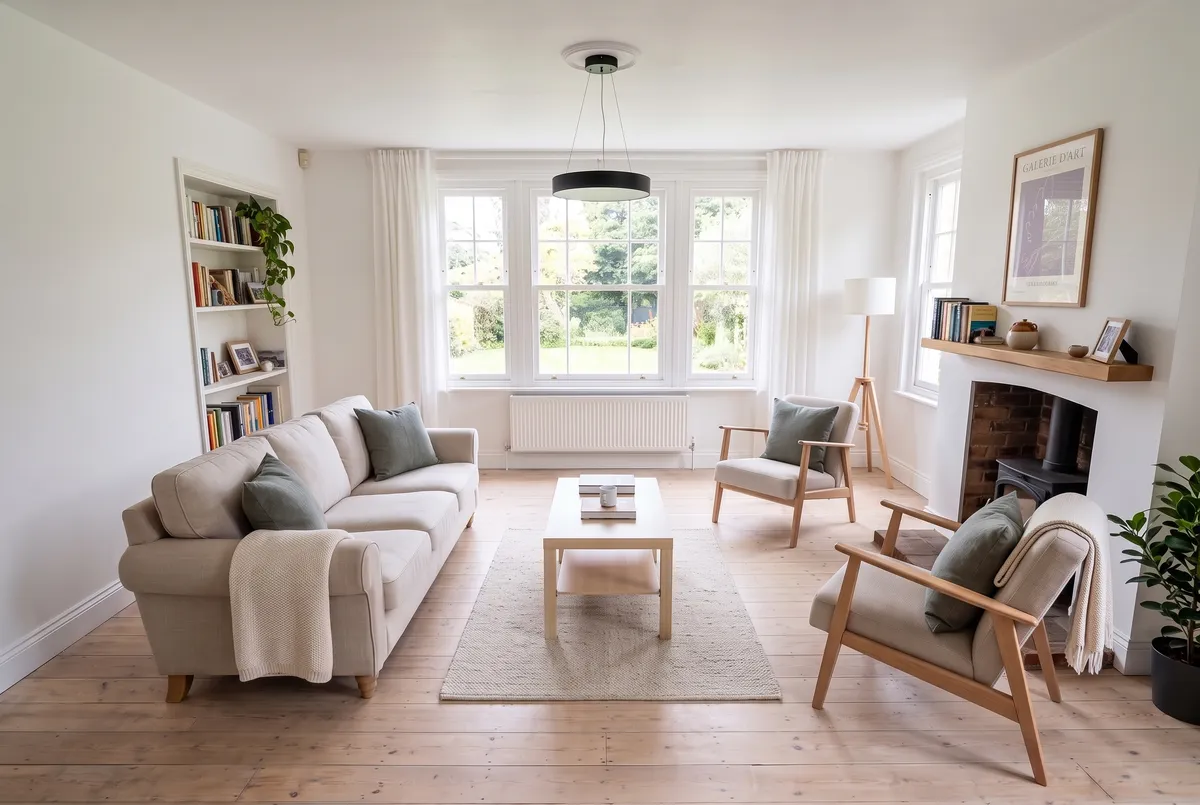
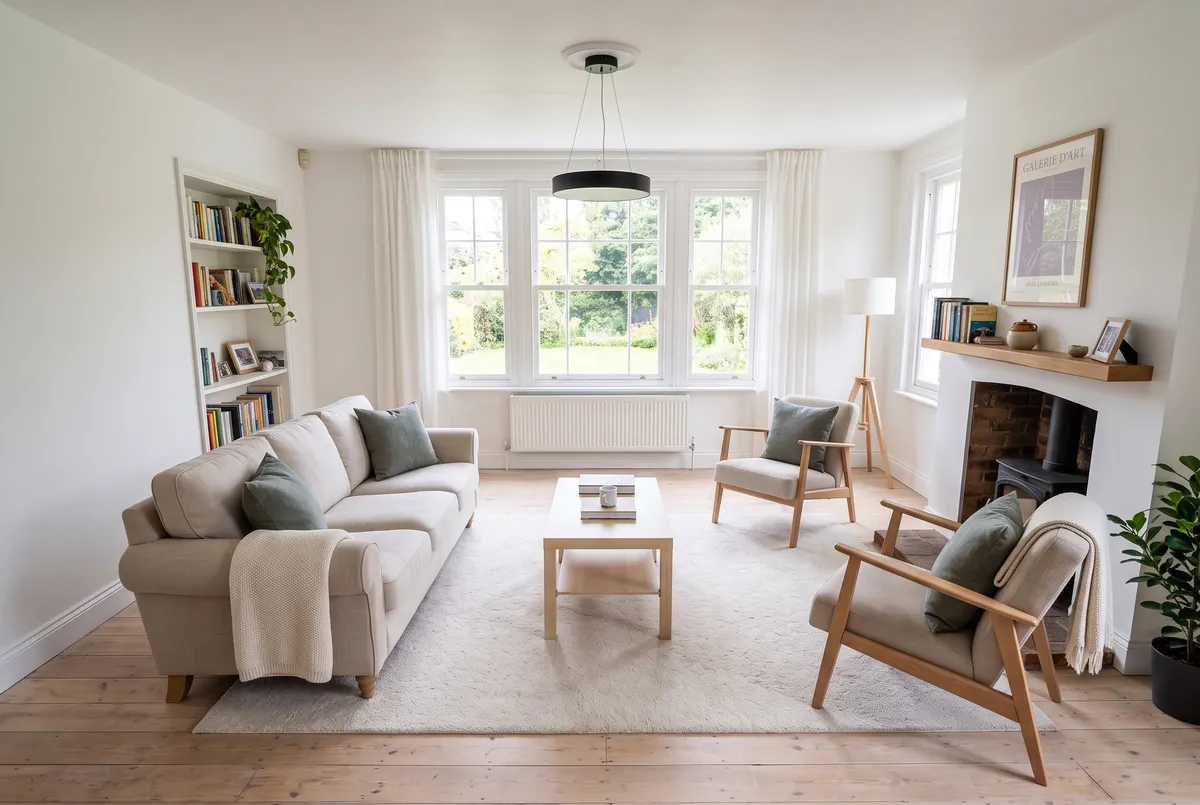
This is a Scandinavian living room we designed: a three-seat sofa (IKEA SALTSJÖBADEN, £449), two armchairs facing each other (IKEA EKENÄSET, £179 each), a birch coffee table (IKEA BORGEBY, £129) and an off-white, low-pile rug (IKEA LANDSVÄG). The whole room came to £1,038 for 12 products, all from IKEA and B&Q.
Below are two pictures of it from the same angle, with only the rug changed. In the first, the rug is about a third of the size we ended up with, sitting in the middle of the floor with no furniture legs on it.
Nothing else has moved, but the sofa and chairs now look like they're parked around the edge of the room, and the floor feels bigger and emptier than it did. The rug looks like a doormat that wandered in.
In the second, it's LANDSVÄG at 200 x 300cm. The front legs of the sofa and both armchairs stand on it, the coffee table sits in the middle, and there's bare floor showing all the way round.
The room reads as one grouping now, and it looks larger, because the eye isn't stopping at the edge of a small rug before it reaches the furniture.
What size rug do you need for a living room?
Common UK rug sizes run 120 x 170cm, 160 x 230cm, 200 x 290cm (or 200 x 300cm) and 240 x 340cm. Rugs of Dorset suggests 160 x 230cm for a smaller lounge, 200 x 290cm for a medium room, and 250 x 350cm or bigger if you want all the furniture on the rug.
For a living room with a three-seater, we'd start at 200 x 290cm. A typical three-seater is around 200–230cm wide, and a rug that size is the first one that can reach past both ends of it. Measure yours before you trust any chart, including ours.
A lot of the advice online is American and talks in feet (8x10, 9x12). Those convert to roughly 240 x 300cm and 275 x 365cm, which is why UK sizes never quite match them.
Should the sofa sit on the rug?
In most rooms, yes, at least the front legs. Opinions do vary, though. IKEA suggests at least a third of the sofa on the rug, and one designer quoted in Livingetc says it's fine if the sofa is only half on. We'd go for the front legs because it's the version that still looks right when you step back from it, and it's easy to check: if you can see daylight between the rug and the front feet, it's too small.
If the sofa sits against a wall, put 20–25cm (8–10in) of the rug under the front feet. If you can see the back of the sofa, because it's floating in the room or backing onto a walkway, the rug is better running about 25cm past it.
How much bigger than the sofa should the rug be?
Roughly 15–25cm past each end of the sofa. Love Rugs suggests 15–20cm, and the designer Livingetc spoke to goes for about 25cm. That gives a 200cm sofa a rug of about 230–250cm along that side, and a 230cm sofa something closer to 260–280cm.
This is where one popular piece of advice doesn't hold up. One UK rug retailer calls 160 x 230cm the most popular size and says it gets the front legs of the furniture on. It will, for a small two-seater. For a three-seater it doesn't work: a 200–230cm sofa on a 230cm-long rug leaves almost nothing past either end, and none at all if the sofa is at the wide end of that range. You get the front legs on, but the rug is flush with the sofa's sides and looks like it's been cut to fit a different room.
So the sum is your sofa's width plus 30–50cm, along the side the sofa sits on. Do that before you look at a single listing.
How much floor should show?
About 20–45cm of bare floor round the edges. The "18-inch rule" you'll see on Ideal Home and elsewhere is about 45cm, and it's a good target in a bigger room. In a small one, go nearer 20cm, and it's fine to go tighter still if the alternative is a smaller rug.
UK living rooms aren't big. A new-build lounge averages around 17m², and a terrace is usually 15–20m². In a room that size a rug that fills the floor to the skirting boards looks heavy, so leave the margin. Also keep the rug about 10cm from any radiator so it isn't sitting on the heat.
The rug we chose and what it cost
LANDSVÄG comes in four sizes:
- 80 x 150cm: £19
- 133 x 195cm: £39
- 160 x 230cm: £59
- 200 x 300cm: £89
We used 200 x 300cm at £89. The 160 x 230cm would have been £59, so going up a size cost £30 in this room. That's about 3% of the £1,038 total, and it's the difference between the two pictures above.
The trade-off is plain: a bigger rug costs more, and you might not have the £30. If so, a 160 x 230cm rug still looks better than a small one, as long as you accept it'll sit flush with a three-seater. Spending the difference on the rug rather than, say, another cushion or lamp is usually the better use of it.
How do you check the size before you buy?
Mark it out on the floor with masking tape. It takes ten minutes and it's the most reliable test we know, which is why Houzz recommends it too.
- Measure your sofa's width and note it down.
- Tape out the rug's rectangle with a tape measure, running 15–25cm past each end of the sofa.
- Check that the front legs of the sofa and chairs sit inside the tape.
- Look for 20–45cm of floor showing between the tape and the skirting boards.
- Check you're about 10cm clear of any radiator.
If you're stuck between two sizes, go slightly bigger. A rug that's a touch too large looks generous, and one that's a touch too small looks like a mistake.
What if your rug is already too small?
You've got two options that don't involve buying again. The first is to move it under the coffee table and treat it as a small island for that one piece, rather than letting it float in the middle of the room. It won't help the sofa, but at least it'll look intended.
The second is to layer: put a larger, inexpensive flatweave or a plain jute-style rug underneath and use the smaller one on top. That gets the front legs on the large one and keeps the rug you already own. Try the tape trick first, so you know how big the base layer needs to be.
What about dining tables and beds?
The rules are similar, with different numbers. Under a dining table, the rug should run about 60cm past the table on every side so the chairs stay on it when they're pulled out. For a bed, aim to have the lower two-thirds of the bed on the rug, so it sticks out at the sides and the foot.
FAQ
What size rug for a living room?
For a three-seater sofa, we'd start at 200 x 290cm or 200 x 300cm. It's the first common size that lets the rug run past both ends of a sofa that's 200–230cm wide, while keeping the front legs on it.
Should a rug go under the sofa?
Under at least the front legs, yes. Against a wall, 20–25cm of rug under the front feet is a good guide. IKEA suggests a third of the sofa as a minimum, and it's fine to go further.
Is 160 x 230cm big enough for a living room?
For a smaller lounge with a two-seater, yes. With a three-seater it'll sit almost flush with the sofa's ends, so it's worth measuring first.
How far should a rug stick out from the sofa?
About 15–25cm past each end, and 20–25cm under the front feet when it's against a wall.
- Rugs of Dorset: rug sizes
- Love Rugs: rug size guide UK
- The Rugs Collection: common rug sizes explained
- Livingetc: how to choose a living room rug
- IKEA: choosing the right size rug
- Ideal Home: the 18-inch rule for rugs
- Ruggable UK: rug sizes
- Houzz UK: how to find the right-sized rug
- Homebuilding & Renovating: average living room size