Cosy living room ideas
The renovating.co.uk team · Prices checked 25 Sep 2026
For a cosy living room, paint the walls a shade or two deeper, take the ceiling a shade darker than the walls, then turn the main light off and use lamps at low level. Most advice for a cosy living room is about things you add (throws, candles, cushions). This is about the room itself, and it costs a few tins of paint and a lamp or two.
Here it is in four steps, in a Victorian living room we designed with real IKEA and B&Q products, each picture adding one change to the one before.
What do the four steps look like in a room?
The room has a chimney breast with a fireplace, a cream two-seater sofa (IKEA VIMLE, £699), a dark-stained coffee table (IKEA IDANÄS, £249), a pink and beige rug (IKEA JÄRNVÄG, 160 x 230cm, £99), white linen curtains (IKEA DYTÅG, £69) on a brass pole, and a five-arm brass ceiling light (B&Q GoodHome Inuus, £53). The walls are Dulux Heritage Sage Green (£49 for 2.5L at B&Q). The whole room came to £1,488 for 12 products.
The first picture is that room by day: pale sage walls, a white ceiling, one ceiling light and no lamps lit.
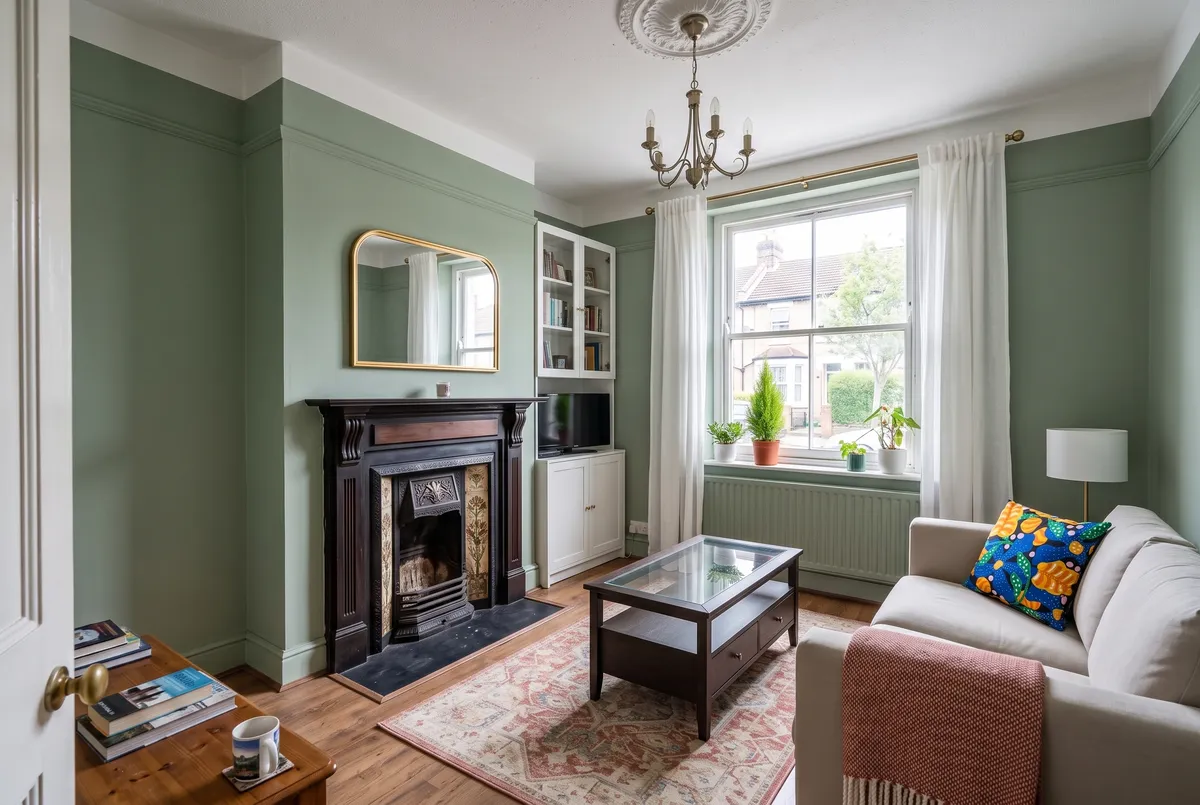
It's pleasant and a bit exposed. The window does all the work, and the ceiling is a big, bright, flat surface above everything.
The second picture takes the walls a shade or two deeper, still clearly the same green and still a mid-tone.
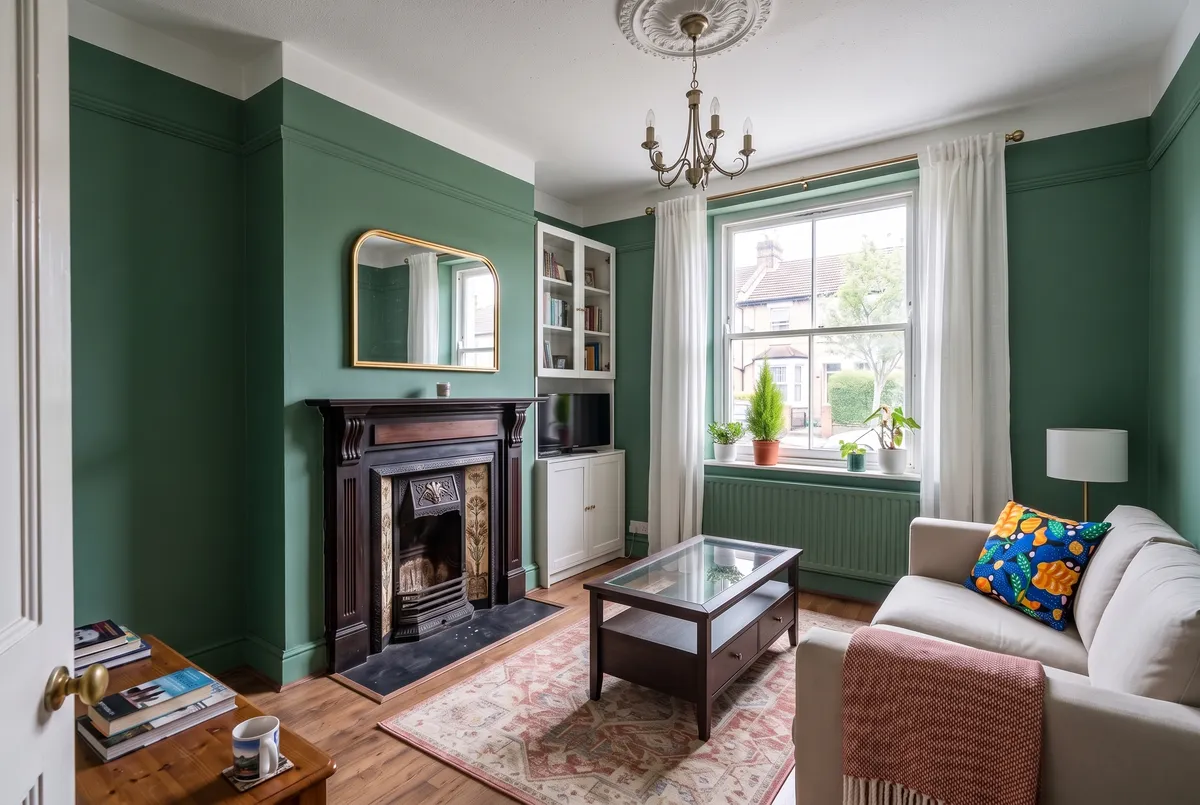
The room gets richer straight away. The fireplace and the dark furniture stop looking like they're sitting against a pale backdrop.
In the third picture the ceiling is a shade darker than the walls.
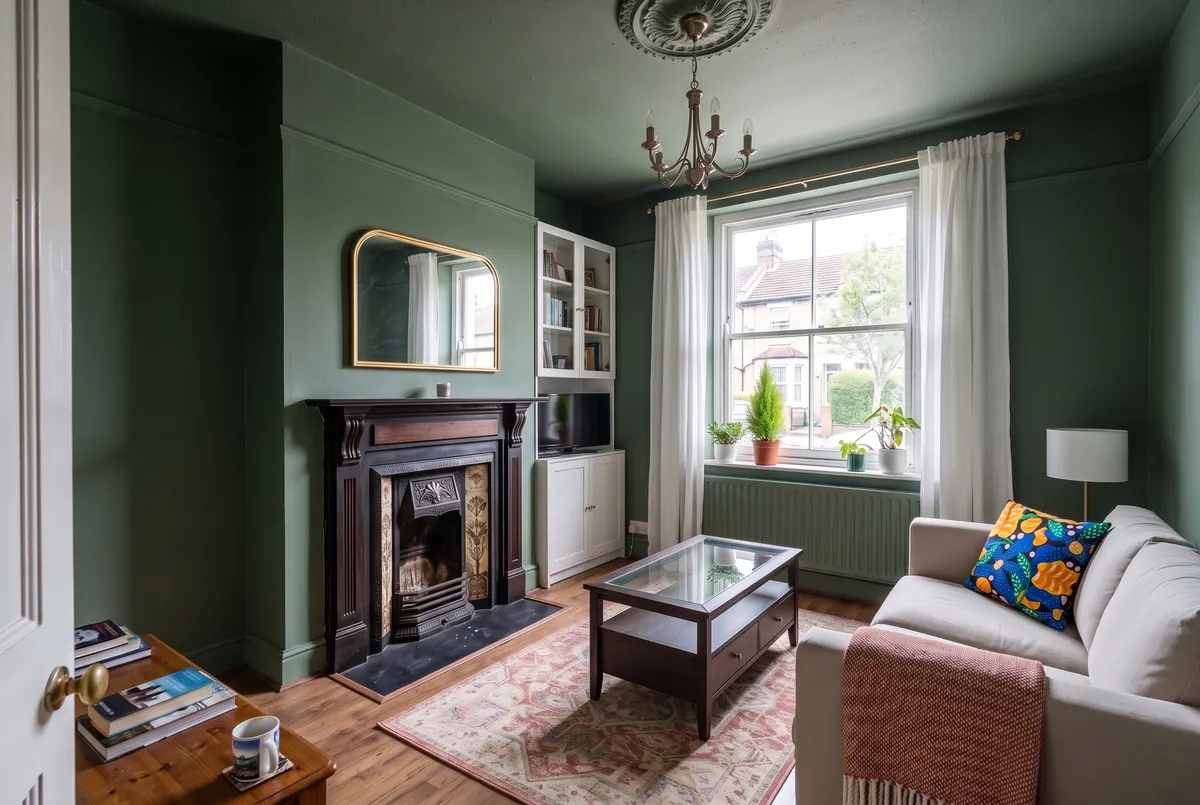
The ceiling comes down. It reads as a lid close above you rather than a pale expanse, and the ceiling rose picks up some shadow.
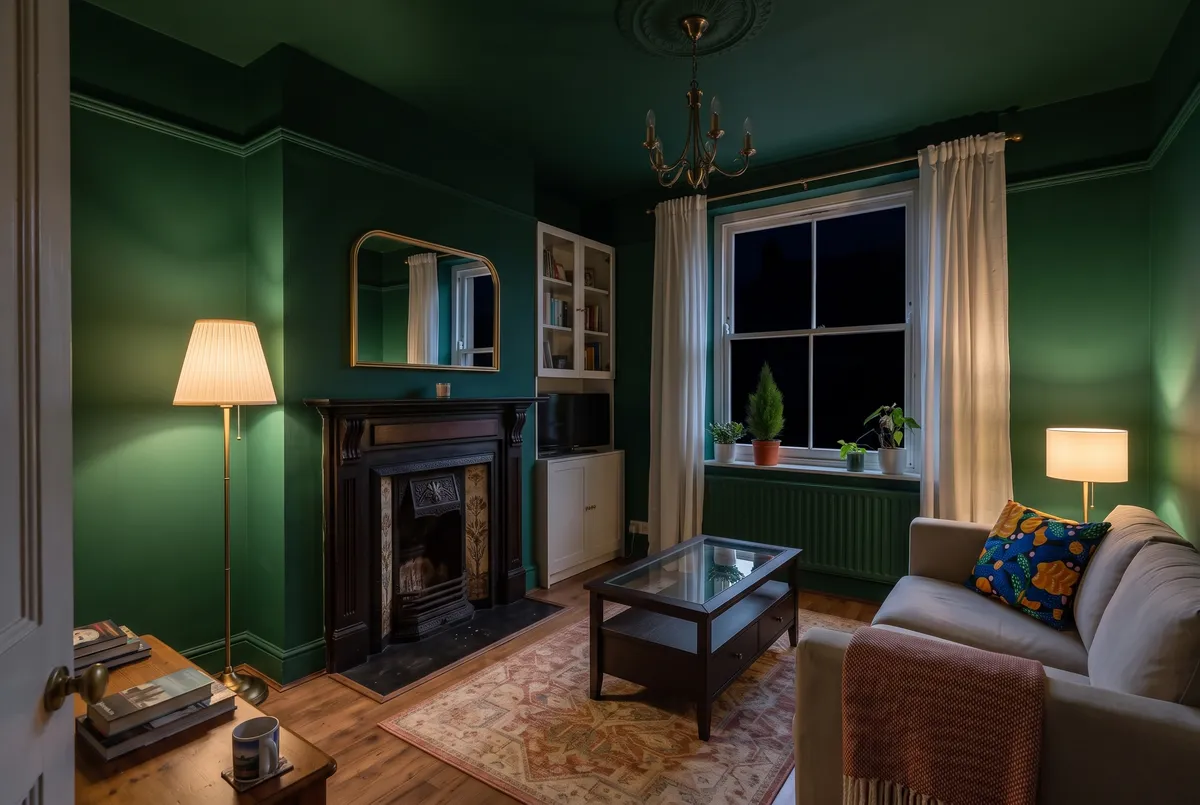
The fourth picture is the same room in the evening, with the ceiling light off and lamps lit.
 BeforeAfter‹›
A brass floor lamp stands by the fireplace and a table lamp sits on the right, each throwing a pool of warm light onto the wall behind it. The window is dark, and the room looks like somewhere you'd settle for the evening. We think it's the cosiest of the four, and most of that comes from the lighting, with the paint giving the light something to land on.
Why do the walls and ceiling matter more than the cushions?
Because they're most of what you see. A throw is a small area, and the walls and ceiling are most of the room.
John Lewis suggests a wool rug, tactile cushions, blankets and "a couple of table lamps and floor lamps" instead of overhead lights. B&Q starts with layered lighting and "warm colours", and Furniture Choice includes dark walls in forest green, navy or charcoal. In the four pictures, each change builds on the one before: paint first, then the ceiling, then the lamps.
How much deeper should the walls go?
One or two shades, and stay in the same colour. Here that's a sage that's still recognisably sage, only richer. It stays a mid-tone: Furniture Choice is right that a deep forest green can be cosy, but a full step into dark is a bigger commitment than a shade or two, and it's harder to undo.
On cost, the paint is the same either way. Every Dulux Heritage Velvet matt colour at B&Q that we looked at is £49 for 2.5L, so a deeper shade of the same range doesn't cost more than the pale one. We haven't worked out how many tins your room needs, because that depends on its size.
Should you paint the ceiling darker than the walls?
In a high-ceilinged room, we'd try it, though the usual line is the opposite: Dulux says a bright white ceiling "can create the illusion of more space and light", which is a good reason to keep it white in a small, dark room. It also says that painting walls and ceiling in the same shade creates "a cosy, cocoon-like feel", and that two tones add "drama and personality" with a cosy feel. The third picture goes a step further than Dulux's same-shade version, with the ceiling a notch darker than the walls.
The downsides are real. Fantastic Handyman points out that dark shades "may create a feeling of sitting in an even smaller space", that scuffs and stains show more, and that it takes more paint. If your ceiling is low, or the window is small, we'd stop at walls and lamps and leave the ceiling white.
How do you light a living room to feel cosy?
Switch the main light off and use lamps at low level, so the pools of light sit at about seated height rather than up at the ceiling. John Lewis says to "switch off those overhead lights" for table lamps and floor lamps, and B&Q's advice is to layer lighting with table lamps, wall lights and candles instead of harsh overhead light.
For the bulbs, a lighting retailer, Moonlight Design, says living rooms and bedrooms suit warm white, around 2,700K to 3,000K, and Furniture Choice suggests dimmable, warm-toned bulbs. The pack will have the Kelvin number on it.
The lamps in the fourth picture:
- IKEA ÅRSTID brass/white table lamp: £15, on top of the £1,488
- A brass floor lamp, which isn't one of the room's listed products. IKEA's floor lamps run from £17 to £89, including ÅRSTID at £50 and RINGSTA / SKAFTET at £39.
The room's own table lamp is a RINGSTA / SKAFTET (£26), so the £15 ÅRSTID is an extra, not a swap. The same RINGSTA / SKAFTET in the 41cm size is £20 if you're after a smaller one.
The trade-off with lamps is sockets: you need them in the right places, and a floor lamp has a cable you'll see.
What about the rug?
A rug helps too, by pulling the seating together so the sofa and table read as one group. The rug in this room is the JÄRNVÄG in 160 x 230cm at £99. The 200 x 300cm is £139, so £40 more for a rug that goes further under the sofa.
How do you check it before you commit?
- Buy a sample pot of the deeper wall colour and paint a large piece of lining paper, so you can move it round the room.
- Tape the same card to the ceiling next to your current white and look at both in the evening with the main light off.
- Put your lamps where you'd really put them and check the light lands on a wall and not into your eyes.
- Do the whole test at the time of day you actually use the room.
If a sample looks heavy at night, go back one shade.
FAQ
How do I make my living room cosy?
Deepen the walls a shade or two, take the ceiling a shade darker if it's high, and light the room with lamps instead of the main light. After that, add rugs, throws and cushions.
How do I make a big living room cosy?
Bring the ceiling down with colour and break the light up into pools with lamps. A rug under the seating helps the sofa and table read as one group.
What colour makes a living room cosy?
Warm, deeper colours do: B&Q's list mentions terracotta, umber brown and mustard, and ours is a deeper sage. The shade matters less than keeping it a mid-tone.
Does a dark ceiling make a room look smaller?
It can. Fantastic Handyman warns a dark shade can feel smaller, so we'd keep a white ceiling in a low or dim room.