Do dark colours make a room look smaller?
The renovating.co.uk team · Prices checked 25 Sep 2026
Dark colours don't have to make a room look smaller. A deep colour on every surface, ceiling and skirting boards included, usually makes a small room read as bigger, because the corners blur and there's no edge to measure the room by. Dark walls against a white ceiling are what box a room in, and that's the version most people end up with by accident.
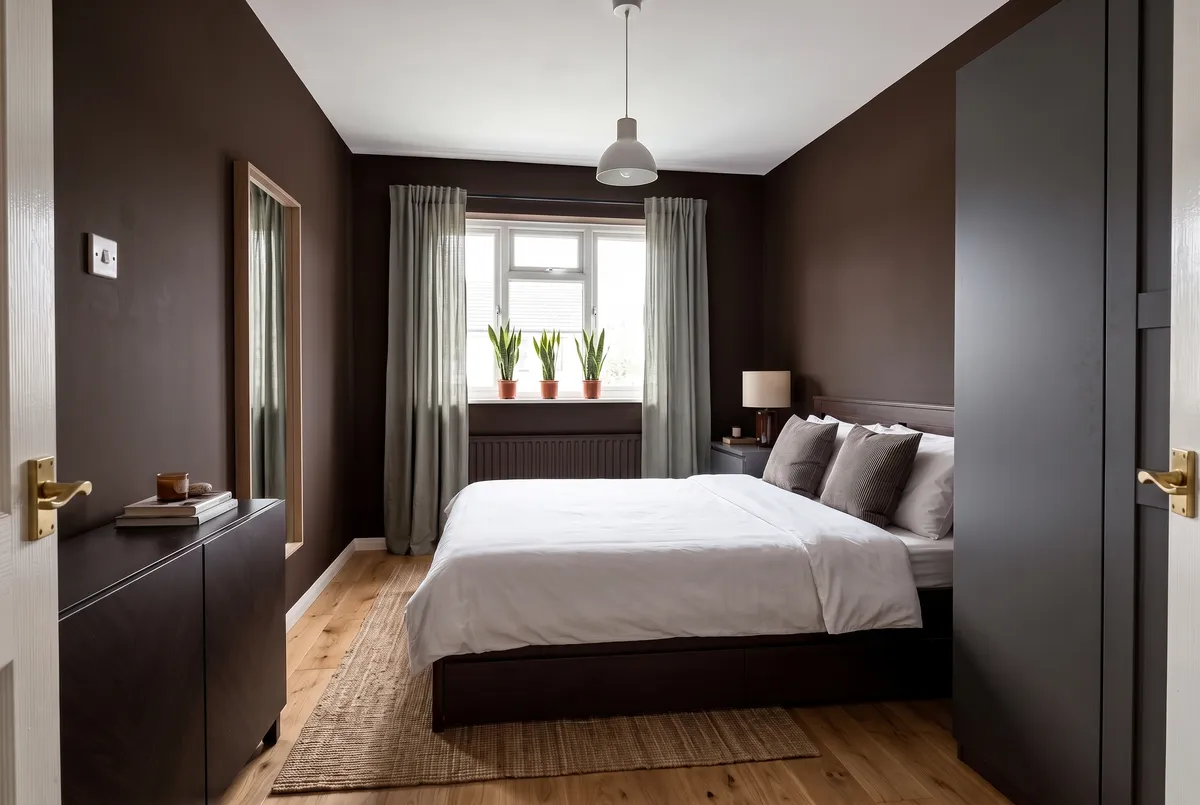
 dark walls, white ceilingdark everywhere
‹›
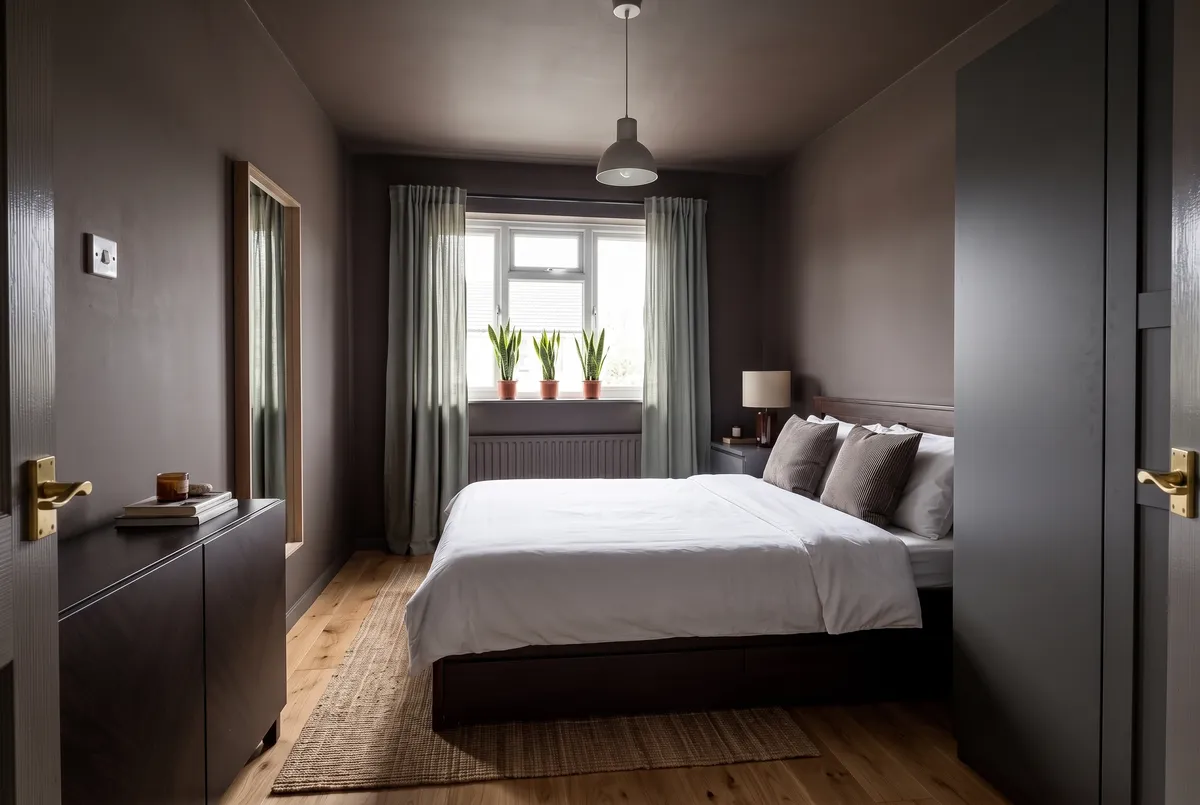
Here's the same bedroom both ways, in a room we designed with real IKEA and B&Q products.
What do dark walls look like with a white ceiling?
This is a small Japandi double bedroom we designed, roughly 3.2 x 4.2m. The bed is an IKEA IDANÄS in dark brown (£499), the wardrobe is a PAX / BJÖRNESKOGEN in dark grey and walnut (£381), the floor is B&Q GoodHome Bishorn oak flooring (£64.96 for 2.03m²) and there's a 200 x 300cm LOHALS jute rug (£179). The room has 13 products, £1,626 in all.
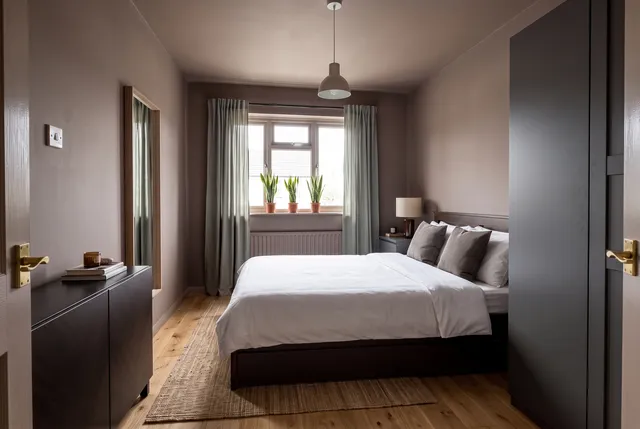
In the first picture the walls are a deep brown and the ceiling, skirting boards and door are left white.
The white ceiling is the brightest thing in the room, with a hard line running all the way round it, like a lid. The room doesn't look tiny, but you can see exactly where it stops, which is the problem: the eye finds the boundary quickly and measures the room by it.
What happens when the ceiling, skirting and door go dark too?
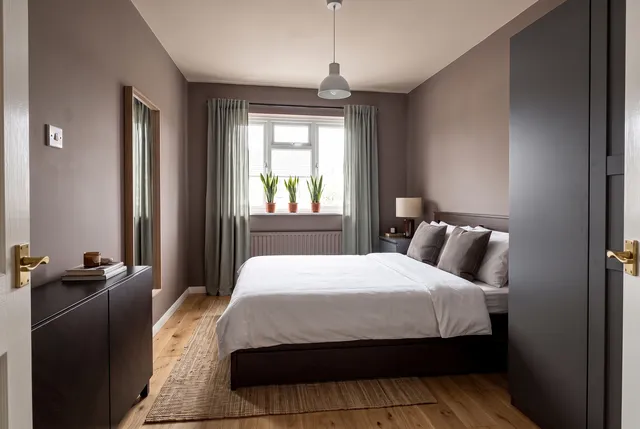
In the second picture the walls, ceiling, skirting boards, door and frames are all painted the same deep shade.
The line between wall and ceiling disappears. The corners go soft, and your eye travels to the window and the pale oak floor, which are now the only bright things in the picture. The room feels deeper and more enclosed, and less like a box. We'd call it cosier rather than bigger, and in a room this size that's a good result.
There's a trade-off: the room is darker overall and needs more light from you, which we cover below. The colours on screen also won't match a paint swatch exactly, so judge the effect, not the shade.
What do the experts say?
They split.
Interior designer Caroline Foran, quoted by TheJournal.ie, says the rule against painting a small room dark is a myth, and that dark, cool tones like navy can absorb the light and create the illusion of space. Livingetc quotes the designer Kelly Wearstler saying dark hues can make a smaller room feel bigger, and says matching dark walls to a dark ceiling blurs the boundaries and creates the illusion of taller ceilings.
Others disagree. Starry Homestead warns against dark colours in small rooms without much natural light because they can feel cramped or cave-like. Euphoria Interiors says in one place that painting walls, skirting and ceiling one deep tone makes the room recede, and in another to lift the ceiling and floor with lighter tones so the room keeps its height. Dulux suggests paler woodwork to frame dark walls.
The two pictures side with the first group on the ceiling. A pale ceiling over dark walls is the version that looks smaller, so we wouldn't do it in a small room unless you want that contrast. If you do like the framed look it's a legitimate choice, and paler woodwork is a much cheaper way to try it than a repaint.
Euphoria says charcoal grey suits rooms of about 120–200 sq ft (roughly 11–19m²), which would include this 13.4m² bedroom.
How dark is too dark for a small room?
It depends on how much daylight you get. Dulux says that in a room with plenty of natural light, dark colours can feel surprisingly airy. Wearstler, in the same Livingetc piece, advises a dark colour with a cool base for south-facing rooms and one with a red base for north-facing rooms, which are darker.
A north-facing box room with a small window is where we'd choose a deep warm brown or aubergine over a charcoal, because a cold dark grey will feel colder than it looks in the shop. This bedroom has one window, and the dark door and window frames still work because the floor and the window do the brightening.
What keeps a dark bedroom from feeling like a cave?
What you add after the paint.
- Warm, layered light. Euphoria says deep walls absorb light, so one overhead fixture isn't enough, and recommends warm white bulbs at 2700K to 3000K. The room has a £15 B&Q pendant and a dimmable IKEA HALGATT table lamp (£35). Add a second lamp on the other side, which would be another £35 if you used the same one.
- Light things low down. The oak floor (£64.96 for 2.03m²) and the jute rug (£179) are the lightest surfaces in the picture.
- White bedding. In the pictures, it's the brightest large area against a deep wall. Dreams says dark bedrooms work through contrast, balancing deep tones with lighter elements.
- A mirror. The IKEA HOVET mirror is 78 x 196cm and £129. It's a pale-framed, reflective surface in a room where most things are matt and dark.
- Texture over pattern. The ÅSVEIG cushion cover (£7) and the DYTÅG curtains (£69 a pair) add texture without adding more colour.
Dreams also says darker colours may help you sleep better if you like a pitch-dark room.
Does it work in a living room?
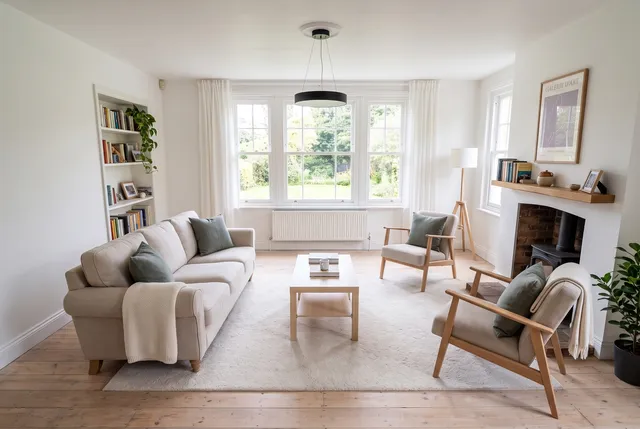
In the same way, yes, with more lighting. Livingetc describes the cocooning effect in a small living room. The difference is furniture: a dark sofa against dark walls disappears, so choose something a shade or two lighter or a different texture. If you want the full version of the technique, our guide to colour drenching covers the ceiling, skirting and finishes.
What does it cost, and what's the alternative?
Paint doesn't cost more because it's dark. In the Dulux Heritage range at B&Q, shades such as Dark Stone, Wild Blackberry, Dark Aubergine and Deep Ultramarine are £49 for a 2.5L tin of velvet matt, the same as Mid Umber, a paler taupe.
What changes is the number of tins. Dark walls with a white ceiling means painting the walls only. Going dark everywhere adds the ceiling, skirting boards, door and frames, so you'll need more tins at £49 each, and the tin tells you how many square metres it covers. The cheaper test is to paint the walls dark and keep the ceiling white first, and see whether you can live with the lid.
On top of that, budget for light: one extra £35 lamp, and warm bulbs.
How do you test it at home?
- Paint a sample on a large piece of lining paper or card, about A2, not a small patch on the wall.
- Tape it to the wall and the ceiling, and look at it at breakfast and again in the evening with the lamps on.
- Measure your window. If the room is small and has one small window, go for a deep warm colour and not a cold one.
- Look at the join where the wall meets the ceiling. If the white ceiling sits above a dark wall in the sample, imagine that line running all round the room.
- Check your bulbs: 2700K to 3000K, and more than one light source.
FAQ
Do dark colours make a room look smaller?
Dark walls with a white ceiling can, because the ceiling becomes a hard edge. The same deep colour on the ceiling and skirting boards usually makes the corners blur, so the room reads as less boxy.
Should you paint a small room dark?
It's fine to, especially a bedroom you mostly use in the evening. We'd go for a deep warm colour, paint the ceiling the same shade, and add more than one light.
Should the ceiling be the same colour as dark walls?
In a small room we'd say yes. A white ceiling over deep walls is the version that looks smaller in the pictures above.
Can you have a dark living room in a small flat?
Yes. Layer lamps, pick a sofa that doesn't match the walls, and test the colour in your own light first.